



What Can You Do if Someone Trespasses on Your Property?
For property owners, land is often their most valuable asset. Whether you own a commercial development in Boston or a residential estate in the suburbs of Massachusetts, maintaining control over who enters your land is fundamental to your rights as an owner.
Unauthorized use of your property is a nuisance and a significant liability risk. If a trespasser gets injured on your land, or if a neighbor’s new fence slowly encroaches on your boundary, the legal and financial consequences can be severe.
When property trespass occurs, knowing the correct response is key. This guide explains what to do if someone trespasses on your property. It can help you decide between seeking immediate removal via law enforcement or pursuing long-term legal solutions through civil litigation to safeguard your assets.
What Is Considered Trespassing in Massachusetts?
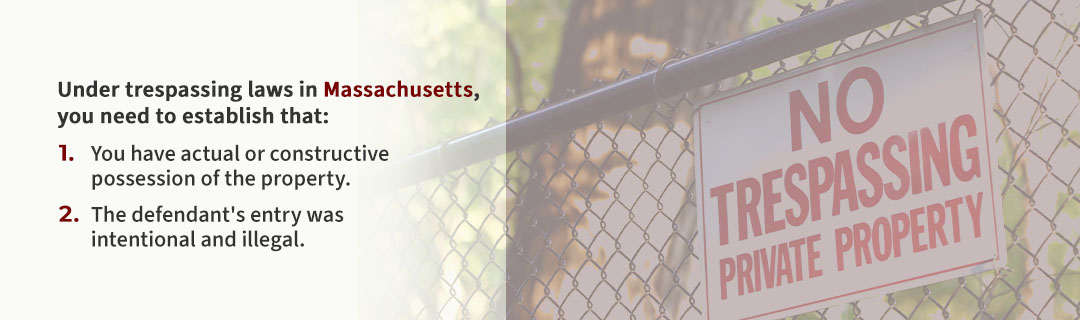
In Massachusetts, civil trespass is generally defined as the intentional entry onto land in the actual or constructive possession of another without permission. Is trespassing against the law? Yes, but the legal remedy for trespassing depends on the nature of the intrusion.
The Elements of Trespassing
To pursue a valid claim, three core elements must typically be present:
- Intentional entry: The person intended to enter your land. Notably, they do not need to know the land belongs to you — the intent to walk on that specific patch of ground is sufficient.
- Lack of consent: You never gave permission for the person to be there, or you explicitly revoked permission you previously granted.
- Interference: The person’s presence interferes with your right to exclusive possession and “quiet enjoyment” of your property.
Common Examples of Trespassing in Greater Boston
Trespassing is not always a stranger cutting through your yard. In our practice, we often see:
- Encroachment: A neighbor building a shed, fence, or retaining wall that crosses your property line by even a few inches.
- Unauthorized use: Construction crews for a neighboring development using your driveway or staging materials on your land without an easement.
- Illegal dumping: Contractors or individuals leaving debris on your commercial lot.
How Do You File a Civil Complaint for Trespassing?
In order to pursue claims for civil trespass in a Massachusetts Trial Court, such as the Superior Court, District Court, or Land Court, a property owner or occupant must file a civil complaint seeking to remove the trespasser from entering their property – in many cases relief known as an “injunction” is sought to order a trespasser be removed from your property and/or ordered to stop future entry into your property. Such a civil complaint in Massachusetts can also request money damages sustained by the property owner due to the trespass activity.
The Notice Requirement
Under Massachusetts General Laws Chapter 266, Section 120, a person can generally only be arrested for trespassing if they enter or remain on your property after having been forbidden to do so. This “forbidding” can happen in two ways:
- Direct communication: You (or a person with lawful control of the premises) tell them to leave.
- Posted notice: You post clear “No Trespassing” signs that are reasonably visible to anyone entering the land.
Serving a Formal Notice
Serving a formal “No Trespass Notice” is often the best recourse for persistent individuals. This written document explicitly forbids the individual from returning. To make it enforceable, we recommend sending it via certified mail or having it served by a sheriff.
Seeking Injunctions
An injunction is a court order that legally compels a person to do or stop doing something. If a neighbor repeatedly drives across your lawn despite your warnings, Calabrese Law Associates can petition the court for a preliminary or permanent injunction. If your neighbor violates this court order, they face severe legal consequences, including potential contempt of court.
Suing for Damages
If the trespasser caused physical damage — such as destroying landscaping, breaking locks, or dumping hazardous waste — you can sue for the cost of repairs. In commercial contexts, you may also be able to claim loss of use damages if the trespassing prevented you from using your property for business operations.
Treble Damages for Trees
Massachusetts law takes the protection of trees very seriously. Under Massachusetts General Laws Chapter 242, Section 7, if a trespasser willfully cuts down or destroys trees, timber, or underwood on your land without permission, you may be liable to recover three times the value of the damaged trees. This protection extends to agriculture as well, allowing you to seek similar damages for the willful destruction of garden produce or field crops. These statutes are powerful tools for property owners, turning a simple dispute into high-stakes litigation.
How Do You Handle Encroachment and Boundary Disputes?
One of the most complex forms of trespassing is encroachment, where a structure is built partially on your land. This is often a permanent type of trespass that typically is not resolved without a civil complaint for trespass in a Massachusetts Trial Court.
The Risk of Losing Property Rights
If you allow a neighbor’s fence or driveway to remain on your property for 20 years, they may eventually claim legal ownership of that strip of land through a process called “adverse possession.”
The Legal Solution
To protect your property rights, you may need to initiate boundary line litigation or file a “Quiet Title” action to confirm your ownership. The goal is to obtain a court judgment confirming your ownership and ordering the removal of the encroaching structure. In some cases, we can negotiate a solution where the neighbor pays for a formal easement, granting them limited rights to use the land while preserving your underlying ownership and value.
Why Trust Calabrese Law Associates?
Calabrese Law Associates provides industry-leading legal representation in real estate, construction, business litigation, and other practice areas for both individuals and corporate clients. Our attorneys deeply understand that real estate disputes are stressful and high-stakes, which is why client interests are always our top priority. Clients have chosen us to represent them for our:
- Real estate expertise: We possess deep knowledge of Greater Boston zoning, easement, and property line laws, allowing us to identify rights and remedies that general practitioners might miss.
- Litigation experience: Whether negotiating a settlement or arguing in court, we provide trial-ready representation.
- Practical solutions: We find efficient, practical solutions that protect your interests without unnecessary delay.
Protect Your Property With Calabrese Law Associates

You have the right to control your property. If you are facing a boundary dispute, encroachment, or a persistent trespasser, do not wait until you lose rights to your land. Contact Calabrese Law Associates today for a consultation with our team. Our attorneys serve clients across the Greater Boston Area, providing the dedicated legal counsel you need to secure your property and your peace of mind.
This publication and its contents are not to be construed as legal advice nor a recommendation to you as to how to proceed. Please consult with a local licensed attorney directly before taking any action that could have legal consequences. This publication and its content do not create an attorney-client relationship and are being provided for general informational purposes only.
Attorney Advertising. Prior results do not guarantee a similar outcome.