



If a contractor abandons a project, you may be entitled to payments for damages. Contractors may also lose their certificate of registration depending on the gravity of the situation. While you can file a lawsuit against your contractor, arbitration and mediation processes can also get you a mutually beneficial result. You will have to take certain steps to get the appropriate reimbursement. This article breaks down what happens if a contractor abandons a job and what you can do about it.
What Constitutes Job Abandonment by Contractors?
What legally constitutes job abandonment depends on your contract. Consider the missed milestones and deadlines, scope of work, unfulfilled deliverables, and the consequences of unpaid services. For instance, your contract may stipulate that missed payments lead to work stoppage.
In Massachusetts, contractors cannot abandon projects without justification. Penalties depend on the severity of the violation and its effects on the complainant. Massachusetts law allows fines of up to $2,000 for each violation, assessed against the contractor, and multiple violations can be penalized separately. Contractors must pay the assessed amount within 30 days. There can be more than one administrative penalty. Contractors may also lose their certificate of registration to practice in the state or have their certificate suspended.
What You Can Do if the Contractor Abandons Your Project
Knowing what your rights are if a contractor abandons your construction project can help you recover costs and hire a new, more competent contractor. The following steps should help you:
1. Reach out to the Contractor
To know for certain whether the contractor abandoned their job, reach out and communicate. Apart from nonpayment issues, which can be justified in a contract, there may also have been a labor shortage due to injured workers or challenges in acquiring new materials.
Understanding whether delays are temporary avoids unnecessary legal processes. However, you can also mutually decide to part ways in exchange for a partial refund.
If a contractor states they won’t be able to meet deadlines, this can be considered anticipatory breach or repudiation — where the contractor makes it clear before the performance is due that they will not perform the contract. You may be entitled to legal remedies listed in your contract, such as payment for damages. Under Massachusetts law, if one party makes a clear, unequivocal refusal to perform, the other party may treat it as an immediate breach and sue.
2. Review Your Contract
Your contract outlines your rights and the actions you can take in case of a breach. When suing a contractor, you need to prove that the contractor failed to perform their duties or meet industry standards. If the contractor misused the funds and spent the money on expenses other than the project, they may be liable for treble damages, or payment up to three times the amount of misused funds.
In Massachusetts, you need the following to prove a claim:
- You, the plaintiff, engage in the activity for personal, family, or household purposes.
- The contractor’s, or the defendant’s, actions were deceptive and unfair.
- The contractor’s actions have resulted in your loss of money or property.
3. Document Activities
Keep a record of all contractor communications, including emails, text messages, and notes. Include messages the contractor didn’t respond to. Document your transactions, including invoices and receipts. Then, take photos of the site to showcase its state after the job abandonment. Ideally, you should also have photos of the site before abandonment.
Record which tools and materials have been left behind. While this documentation may be helpful in court, it can also be informative to the next contractor you hire. The documentation identifies how much work the original contractor did and what the next contractor should continue.
4. Send a Demand Letter
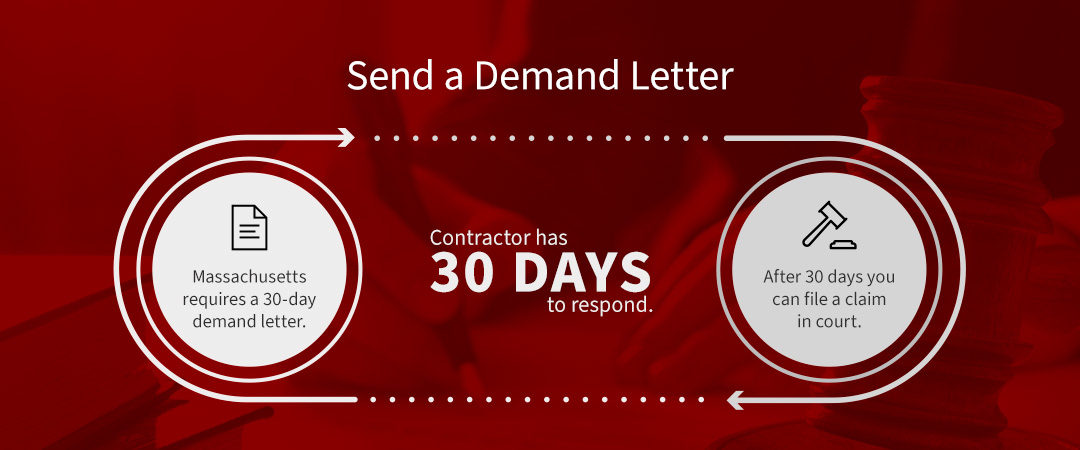
A demand letter formally notifies a contractor of their contract breach. Massachusetts requires a 30-day demand letter, where the contractor has 30 days to respond before you can file a claim in court. This letter outlines:
- Your complaint: Describe the unfair or deceptive practice you experienced from the contractor. You don’t need to include relevant regulations, but you can do so if you know them.
- What you suffered: Explain the result of the contractor’s unlawful actions, such as monetary loss.
- Your proposed solution: Include the relief and the amount of money you demand to recover. Your demand should be reasonable, as this affects the court’s decision.
5. Consider Legal Actions
Before you officially file a lawsuit, consider mediation or arbitration to reach a mutually acceptable resolution. You may apply for arbitration through the Massachusetts Home Improvement Contractor (HIC) Program, which can help you resolve disputes and may pay up to $25,000 from its Guaranty Fund if your judgment is unpaid.
If these fail, then litigation may be necessary. Small construction projects may benefit from the small claims court, which often lets you receive a verdict more quickly. In Massachusetts, claims under $7,000 go to small claims court, while larger claims go to the District or Superior Court.
A legal professional can help you determine if filing a lawsuit is worth it. They will also evaluate your case’s strength and file the necessary documents for you. You may be able to seek reimbursement for:
- Financial losses due to subpar or incomplete work.
- Delays and the inconvenience of hiring a new contractor.
- Costs of fixing the contractor’s mistakes.
6. File a Complaint With the Licensing Board
Contractors are usually bonded, where the bond pays the claims made by clients who suffered from the contractor’s failures. Massachusetts does not require bonds for general and home improvement contractors, but cities and counties may have their own requirements. If you file a complaint with the contractor’s licensing board against the bond, you may get partial reimbursement for damages.
7. Hire a New Contractor
Hiring a new contractor gets the project back on track. However, you should review their backgrounds thoroughly and check for licenses, client testimonials, and past work examples. In Massachusetts, contractors should have a certificate of registration.
You should also explain your situation clearly to the new contractor. Discuss the completed partial work, which will help the new contractor assess how to proceed and whether any material can be salvaged.
Why Trust Calabrese Law Associates
Calabrese Law Associates is an industry-leading law firm with experience across different fields. Our comprehensive legal representation helps clients achieve their goals, whether they’re looking to understand their rights or take legal action. Our focus lies on multiple industries, including:
- Construction law
- Real estate law
- Business law
- Government and regulatory practice
Given that each case is unique, we take time to understand our clients’ situations. By prioritizing effective communication and your best interests, we can help you feel at ease.
Exercise Your Rights With Calabrese Law Associates
We understand the frustrations that come with abandoned construction projects. Our team of construction lawyers can help you achieve the optimal outcome for your case, whether you need to file a lawsuit, hope to negotiate an agreement, or are looking for other solutions.
We possess the industry insights that provide effective legal representation. We are also proud to be accessible, communicating and returning phone calls in a timely manner. We understand how delays contribute to increased monetary losses and further frustration. If you’re in the Boston area and are ready to exercise your rights as a home or property owner, contact our attorneys today.
This publication and its contents are not to be construed as legal advice nor a recommendation to you as to how to proceed. Please consult with a local licensed attorney directly before taking any action that could have legal consequences. This publication and its content do not create an attorney-client relationship and are being provided for general informational purposes only.
Attorney Advertising. Prior results do not guarantee a similar outcome.