


Condos provide a fantastic lifestyle with plenty of benefits, from lower costs and reduced maintenance to a close community and enhanced security. However, this type of living does come with rights and responsibilities that you wouldn’t typically have with other property types.
These rights and responsibilities are usually linked to the condominium owners’ association (COA). When you buy your condo, you’ll either receive an automatic membership to this association, or you’ll be obliged to buy a membership. To choose your perfect property, you need to understand the rights and responsibilities that come with your membership.
How Condominiums Are Split
Before you can fully understand your legal rights to the shared areas in your condo, you need to know how your condo is split. Typically, the condominium master deed will place every aspect of the larger property into one of three categories:
- Unit ownership: This is the part of the condo that each individual member owns.
- General common areas: These are the shared areas in your condo community. General common areas include hallways, reception areas, and elevators in apartment- or hotel-style condos, while common areas can include walkways and recreational areas in detached or townhome-style condos.
- Limited common areas: These areas are owned by all members but are designated to one member for their use, such as assigned parking spots.
General Common Area Rights
As a member of your condo owners’ association, you have rights to the shared spaces in your condo. These rights are generally outlined in the Condominium Declaration, also called the Declaration of Trust or the Bylaws. These typically include the right to:
- Reasonable use: You can’t be barred from accessing or using the general common areas without good reason.
- Implied easements: You can pass through common areas and use shared pathways to access your unit.
- Maintenance: The association generally maintains general common areas using member fees.
- Liability coverage: The association’s master insurance policy will often cover accidents in these zones.
General Common Area Responsibilities
As a member of your condominium owners’ association, you generally have the shared area rights that all other members enjoy — but these rights don’t necessarily come for free. While there may be very few rules on how you maintain your own unit, you’ll have certain responsibilities when it comes to the general common areas.
The main responsibility will be that you’ll have to pay a mandatory fee to your association, which helps to pay for the general common areas’ maintenance costs and other association expenses.
You’ll likely have some nonfinancial responsibilities, too, although these are usually easy to fulfill. Typical responsibilities include reporting any maintenance issues, following the condo owners’ association common area rules as detailed by the legally binding bylaws, and not being a nuisance in the general common areas. A nuisance could involve being noisy, creating a mess, or smoking in nonsmoking areas.
Limited Common Areas
When you move into your condo, you should receive a declaration document that informs you which limited common areas you have access to. Your responsibilities toward the limited common areas may vary from one to the next.
For example, your responsibilities toward a communal balcony that only a select few units can access may be the same as for general common areas. However, a parking space dedicated to your unit alone may not come under these rules. Instead, you may be expected to maintain this area yourself.
Compared to your unit ownership areas, you’re also more likely to need permission from your condominium owners’ association before you can modify any limited common areas, even those dedicated to your use alone.
When Associations Can Restrict Your Access to Shared Spaces
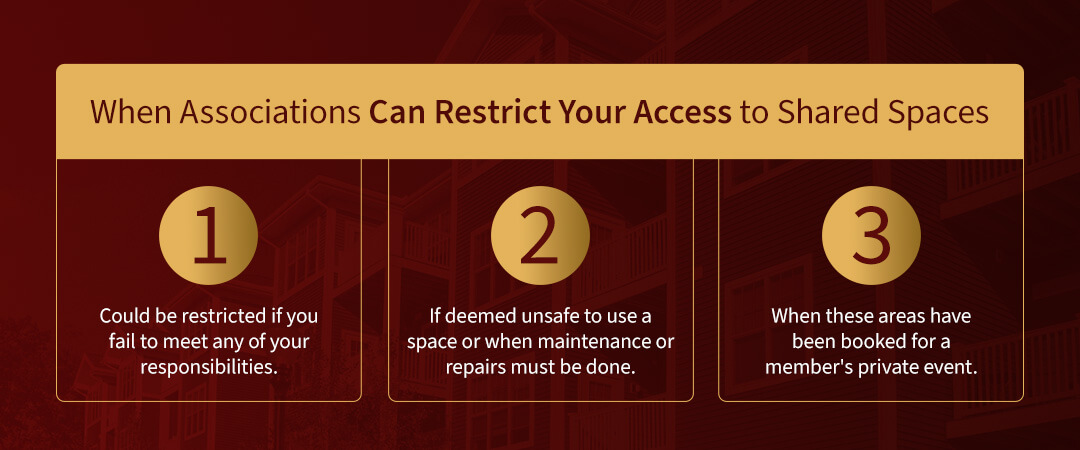
Your access to the general common areas could be restricted if you fail to meet any of your responsibilities. You may also be fined or penalized according to the condominium bylaws.
In other situations, access to general common areas could be restricted to all members. These situations could include when it’s deemed unsafe to use a space or when maintenance or repairs must be done.
The association bylaws may stipulate other times when access to shared spaces is restricted to some or all members, such as when these areas have been booked for a member’s private event, though this situation may not apply to all condominiums. If you’re unsure whether any circumstances may restrict you from accessing the general common areas, check your condo owners’ association bylaws.
How to Protect Your Investment
When you buy or rent a condominium, you invest in more than your unit — you get access to the entire condo community. So if your access or ability to use the shared areas is revoked, you essentially lose part of your investment.
To protect your investment, make sure you understand the condominium documents before you buy your condo. You may even wish to get a professional review of these documents to ensure there are no restrictions or requirements that you may have missed.
You should also check the financial health of the condo owners’ association. This review may give you an idea of whether all amenities in the condominium will be operational, or if some will be unavailable as they wait for maintenance work that the association can’t afford.
What to Do if Your Shared Space Rights Are Violated
If you feel your rights to the shared spaces in your condo have been violated, you can generally take these steps.
- Review the documents: Check what your rights are and judge whether they have been violated.
- Submit a grievance: Dispute the decision by submitting a grievance to begin your association’s formal process.
- Seek mediation: Suggest a way for you and the association to reach an agreement that doesn’t involve a legal dispute.
- Take legal action: If mediation fails or isn’t accepted, you may have to consider legal action. While legal action may not always be an option, you can speak to an attorney to get their professional opinion on whether you have grounds for a legal case.
Why Trust Calabrese Law Associates
At Calabrese Law Associates, our mission is to provide exceptional legal representation for a reasonable fee. Since Massachusetts condominium law is a field of particular focus for us, we’re well-equipped to help with any shared area disputes. Whether your access to these areas has been revoked or the areas are being insufficiently maintained, we can help you resolve the issue with your condo owners’ association.
Our dedication and care for our clients are just some of the reasons why our clients recommend our services.
Condominium Law Attorneys
If you’re considering taking legal action against your condo owners’ association, Calabrese Law Associates can help. Serving the Greater Boston Area and all of Massachusetts, our attorneys are easily accessible and committed to every client we serve.
To find out more about our real estate litigation services for condominiums, contact us today.
This publication and its contents are not to be construed as legal advice nor a recommendation to you as to how to proceed. Please consult with a local licensed attorney directly before taking any action that could have legal consequences. This publication and its content do not create an attorney-client relationship and are being provided for general informational purposes only.
Attorney Advertising. Prior results do not guarantee a similar outcome.